
Find the Solution
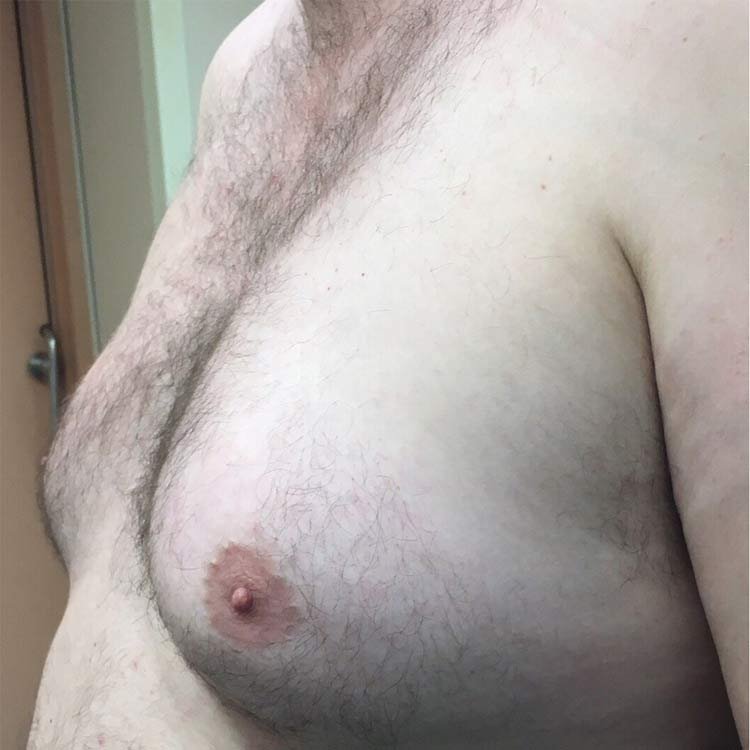
The term gynecomastia refers to the enlargement of fat and glandular tissue in the male breast, which most commonly occurs during adolescence, although it can appear at any stage of a man’s life.
In most cases, gynecomastia actually refers to pseudogynecomastia (lipomastia), where the abnormal breast volume is due not to glandular tissue but to excess fat (often in overweight patients or after significant weight fluctuations).
Several medications and substances can cause gynecomastia, including anabolic steroids, alcohol, or marijuana, drugs containing estrogen, as well as impaired liver function.
It is important to note that gynecomastia, in the vast majority of cases, is not associated with breast cancer.
The Surgical Procedure
Correction of gynecomastia is purely surgical. Liposuction is the preferred method when there is no enlargement of the glandular tissue, that is, in cases of pseudogynecomastia (lipomastia). Liposuction is also used as a supplement around the armpits and the perimeter of the chest to refine the overall contour.
In the classic procedure, a semicircular incision is made at the lower half of the areola. The glandular tissue is completely removed through this incision, and liposuction is then performed to smooth the entire chest surface.
In cases with significant skin laxity, a circular incision around the areola is made, and periareolar skin tightening is performed simultaneously. In very large gynecomastia, a subcutaneous mastectomy or another chest reduction technique may be required.
Anesthesia can be either local with sedation or general, and hospitalization ranges from a few hours up to a maximum of one day.
After the Surgery
After the surgery, the patient wears a special compression vest for 15–20 days. Any mild discomfort around the incision sites usually subsides within 2–3 days, while slight swelling and bruising typically resolve over 7–10 days.
It is recommended to avoid exercise and strenuous physical activity for about 20 days, although the patient can usually resume daily activities from the day after the procedure.
The results are permanent, relieving the man from psychological burden and social discomfort.
Results