
Chemical Peeling: Advanced Formulas, Impressive Results
We all dream of radiant, healthy, flawless skin… chemical peeling is one of the most tried, safe – when performed by an experienced doctor – and effective non-invasive ways to achieve it!
What is chemical peeling and how does it work?
Chemical peeling, or chemical exfoliation, is a medical procedure in which a special chemical solution is applied to the skin to promote its regeneration and remodeling. The mild and controlled injury it causes activates the skin’s natural healing mechanisms. The result is a gradual, targeted exfoliation of the upper layers of the epidermis and the removal of “dead” cells, revealing a new layer with improved tone, texture, and color. At the same time, chemical peeling stimulates the production of collagen and elastin.
It is one of the oldest beauty treatments in the world, with a history dating back to antiquity. References exist from ancient Egypt, Greece, and Rome to various substances applied to the skin to enhance appearance, notably Cleopatra’s milk baths for skin renewal. The history of modern chemical peeling, however, began in the 19th century when Austrian dermatologist Ferdinand Ritter von Hebra discovered that repeated applications of iodine and lead tinctures could reduce freckles. The technique was further developed by dermatologists of the 19th and 20th centuries, culminating in the controlled chemical skin remodeling we know today.
In which cases is chemical peeling applied?
Chemical peeling provides a solution for many skin conditions, such as dull or oily skin, enlarged pores, fine lines and wrinkles, acne and its scars, melasma, discolorations and generally uneven skin tone, actinic keratoses, and photoaging.
However, chemical peeling is not only for those concerned with skin imperfections or dermatological issues but also for anyone who wants to maintain the radiance and youthfulness of their skin.
It is usually applied to the face, neck, décolleté, and hands—areas most exposed to the sun and affected by photoaging and chronological aging—and in many cases also to the shoulders and back.
How many types of chemical peels are there?
Depending on the depth of penetration into the skin, chemical peels are classified as superficial, medium, and deep, with deep peels being the most intensive.
At Spiliopoulos Plastic Surgery Clinic, we perform chemical peels using trichloroacetic acid (TCA) in two different concentrations, tailored to your skin’s needs and the aesthetic goals we aim to achieve. By adopting two innovative formulas, we establish a new standard in medical skin remodeling—scientifically validated, clinically reliable, and biologically advanced.
The 12% trichloroacetic acid formula introduces a next-generation approach with an innovative biphasic precise application system designed to optimize accuracy, tolerability, and clinical effectiveness. The composition combines TCA, growth factors, Boswellia serrata gum, and Bisabolol, providing a synergistic action that stimulates controlled exfoliation, skin regeneration, collagen biosynthesis, and restoration of the skin barrier. This advanced formula contributes to visible skin renewal, improving firmness, hydration, texture, and tone. Additionally, with strong antioxidant action, it targets modern skin concerns such as inflammaging (a low-grade chronic inflammation associated with stress, poor sleep, and diet, manifesting as loss of skin tone, density, and vitality) and digital ageing (premature aging primarily of the face, eye area, and neck caused by prolonged exposure to blue light from digital screens). Thanks to minimal recovery time and limited inflammation, this superficial chemical peel is ideal for all skin types.
The 20% trichloroacetic acid formula represents the next generation in medium-depth skin remodeling, utilizing biphasic solution technology for maximum safety. Like the superficial version, it combines TCA, growth factors, Boswellia serrata gum, and Bisabolol, providing controlled regeneration of the epidermis and dermis, restoration of the skin barrier, and anti-inflammatory support. Its performance in clinical and preclinical models demonstrates a comprehensive regenerative mechanism: from renewal of keratinocytes to activation of fibroblasts and enhancement of antioxidant defense. Its ability to deliver visible results—radiance, collagen stimulation, improved elasticity—with controlled recovery time marks a paradigm shift in protocols for controlled chemical skin remodeling.
What is the procedure for applying chemical peeling?
The procedure is quick and painless. Usually, no local anesthesia is required, as the only sensation you may feel is a slight tingling or burning.
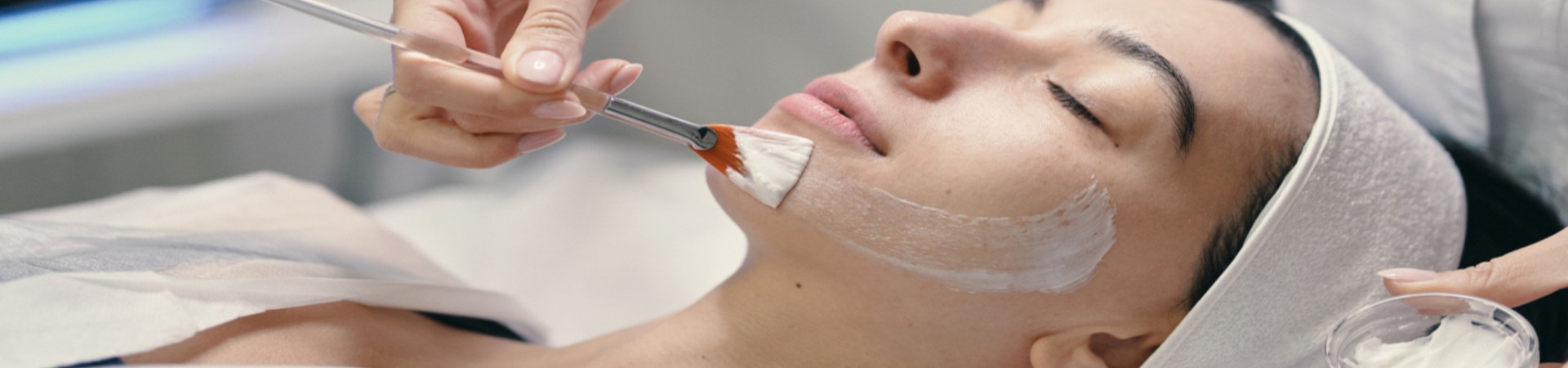
First, your skin is thoroughly cleansed to remove oils, impurities, or makeup residues, and sensitive areas of the face (eyes, nostrils, lips) are protected with a special product. Using a brush, spatula, or cotton swab, the plastic surgeon applies the chemical solution to the skin. The time the peeling remains on the skin varies from person to person (from a few seconds to a few minutes) and depends on the extent of the skin issue and the desired result. Once the required time has passed, the chemical solution is neutralized with a special agent, and a soothing cream is applied.
What is the recovery after chemical peeling?
Immediately after the procedure, you will be given personalized instructions depending on the type of chemical peeling performed. For superficial chemical peels, the recovery is minimal, as you can return to your daily activities the next day.
The treated area will show redness—accompanied by a feeling of “tightness”—which will be mild, lasting 1–3 days for superficial peels, or more pronounced, lasting 7–10 days for medium-depth chemical peels. After the redness subsides, the peeling stage will follow.
Important factors for smooth skin healing and the prevention of spots or discoloration include the regular use of a regenerative cream and a high-protection sunscreen. It is also recommended to allow the skin to peel naturally, without removing the exfoliating skin yourself to prevent scarring, and to avoid intense physical activities and sun exposure.
What is the cost of chemical peeling?
It is an affordable treatment. The type of chemical peeling chosen, the area to be treated, and the condition of each individual’s skin determine the final cost of the chemical peeling, which will be provided during the first consultation.
Are the results of chemical peeling permanent?
The results are permanent regarding acne scars; however, they cannot prevent the natural aging process of the skin or the effects of the external environment on it. For radiant, youthful skin with lasting results, maintenance is usually recommended with mild peelings in combination with other aesthetic treatments from the wide range of services offered at Spiliopoulos Plastic Surgery Clinic as part of a comprehensive skin rejuvenation approach.
What is the appropriate season for chemical peeling?
The ideal season for chemical peeling is autumn and winter. The limited sunlight and reduced intensity of solar radiation act as an “ally” for the “fresh,” more youthful but “sensitive” skin during the first 24 hours after the procedure.
Chemical Peeling Athens
Schedule your appointment at Spiliopoulos Plastic Surgery Clinic to assess your aesthetic needs and choose the ideal type of chemical peeling for you, giving your skin brightness, radiance, and firmness!

